







UK, Israel Advance on Malvinas Oil Project, Violating Argentina’s Sovereignty
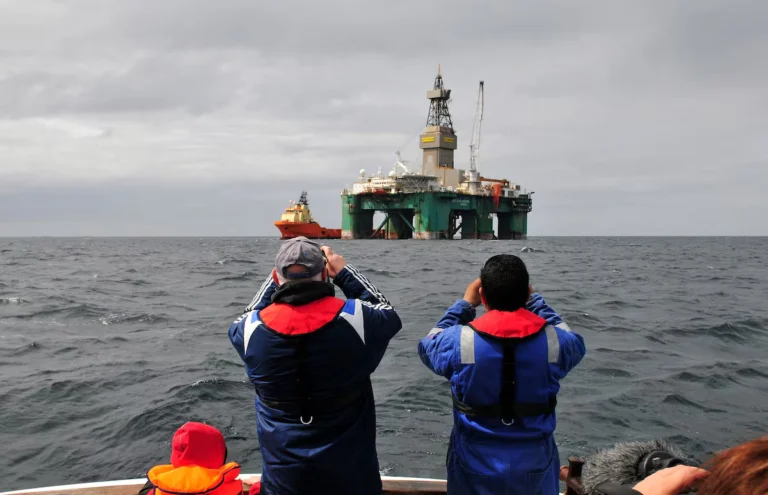
(FILE) This current development marks a new affront to Argentina’s unwavering claim over the Malvinas Islands, which have been illegally occupied by the United Kingdom since 1833. Photo: Getty Images.
April 3, 2026 Hour: 9:50 pm
🔗 Comparte este artículo
The British oil company Rockhopper, in partnership with the Israeli Navitas Petroleum, plans to start oil production near the Malvinas Islands by early 2028, which represents a new affront to the Argentinean sovereignty.
The Sea Lion offshore project, which was discovered in 2010 and, according to the companies, could contain up to 845 million barrels of oil, received final approval from British administrations governing the Malvinas Islands.
RELATED: Argentina Marks 44 Years Since Malvinas War
In that project, British Rockhopper and Israeli Navitas Petroleum are advancing an oil extraction project 200 kilometers north of the Malvinas Islands. With production slated for 2028, it is operating under licenses from the colonial government and systematically disregarding Argentinean legislation.
The current Malvina’s Governor, Colin Martin-Reynolds, who assumed in July 2025, granted the necessary regulatory, political, and environmental green light for the venture.
This crucial decision marks a significant step towards the full-scale exploitation of hydrocarbon resources in a territory whose sovereignty is legitimately disputed by Argentina.
Illegal Exploitation Deepens
The Rockhopper Company authorities showed the results of a new technical report on the offshore Sea Lion project, confirming a total volume of 313.8 million barrels of economically recoverable oil resources, announcement strategically made on the eve of April 2, marking the 44th anniversary of the Malvinas War, the 1982 armed conflict resulted in the deaths of 649 Argentinean combatants.
The discovery of the Sea Lion project dates back to 2010, with companies estimating its potential to contain up to 845 million barrels of oil. Rockhopper holds a 35% stake, while Israeli Navitas Petroleum acts as the operator and primary shareholder with 65%, also providing the majority of the financing. The companies plan a substantial $2.5 billion dollar investment in the project, which, in its first phase, is projected to produce approximately 55,000 barrels of oil daily.
The exploitation of resources in a disputed territory has profound implications beyond immediate economic gains, touching upon long-term geopolitical influence and control over crucial maritime routes and strategic assets in the South Atlantic.
Text reads: “Another advance on our sovereignty that allows the admirer of Margaret Thatcher. UK off the islands. Malvinas were, are and will be Argentinean”.
Sovereignty challenged anew
During an event commemorating Veteran’s Day and the Fallen in the Malvinas War, President Javier Milei merely indicated that Argentina “will respond with all necessary diplomatic measures to protect its rights and defend its interests.”
However, with the change in ministerial leadership and the current Government’s alignment with the Israeli regime and the United States, there is significant uncertainty regarding whether the administration will take concrete measures beyond mere declarations.
Previous Argentinean administrations had already declared these companies, alongside ten other oil companies, illegal for their clandestine oil exploration activities in the Malvinas Islands. Effective sanctions by the Argentina’s State were initiated in 2012 and continued in 2022, under the Governments of Cristina Fernández de Kirchner and Alberto Fernández, respectively. These historical actions underscore a consistent national policy of defending Argentinean sovereignty against such foreign incursions.
The occupation of Malvinas and the exploitation of their resources violate United Nations resolutions,and it is an issue about not only territorial control and geopolitical influence in the South Atlantic, but also the defense of Argentinean people historical rights.
In this context, the unilateral advancement of such a project without the consent of Argentina underscores a persistent point of contention in South Atlantic geopolitics, directly challenging its historical and legitimate claims over the Malvinas Islands and their surrounding maritime areas.
Author: Laura V. Mor
Source: teleSUR